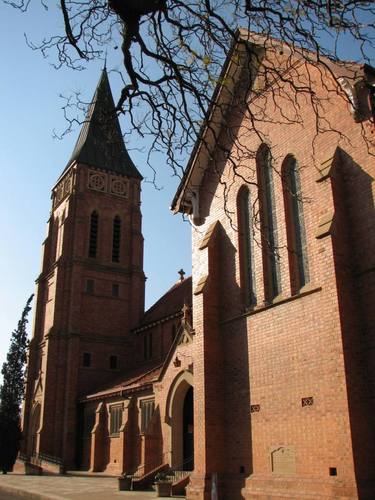
Habere non potest Deum patrem qui ecclesiam non habet matrem. He cannot have God for his father who has not the Church for his mother - St Cyprian of Carthage, Martyred AD 258.
INTO A NEW CATHEDRAL CENTURY The Cathedral Church of St Cyprian the Martyr, Kimberley (Northern Cape, South Africa), celebrated its centenary in 2007/8. The foundation stone of the cathedral was laid on 5 March 1907, and the first phase of the completed building was dedicated on 13 May 1908. But the history of the parish dates back to the beginnings of Kimberley more than 140 years ago, in 1871. St Cyprian's was elevated to the status of a cathedral with the formation of the Diocese of Kimberley and Kuruman in 1911. Its first Bishop, Wilfrid Gore Browne was enthroned here in 1912. Part of this website provides notes on the history of the cathedral and the parish. Please feel free to share your memories or knowledge and contribute to the story. Please comment on or correct any errors.
ST CYPRIAN'S GRAMMAR SCHOOL
St Cyprian's nurtured a family of educational institutions in the past, including a boys' Grammar School, St Michael's, Perseverance and Gore Browne. Following our centenary, the Cathedral took seriously Archbishop Emeritus Ndungane’s vision of a “Restoration of Historic Schools Project” and in 2009 re-opened the St Cyprian's Grammar School. Tel 053-8315066; Fax 0867509960. P.O. Box 10139, Beaconsfield 8315. See http://stcyprians.itgo.com/whats_new.html for email and other details. We opened with 83 students (Grades 1-12) on 21 January 2009. The dedication took place on the Cathedral's Dedication Festival, 13 May 2009. St Cyprian's Grammar School has been growing ever since. THE CATHEDRAL - HISTORICAL INTRODUCTION The life of a cathedral and its parish, like that of any individual, is a pilgrimage of sorts - a journey. The liturgical cycles and seasons, the great festivals, and the sacramental rites around which its members shape and re-shape their lives, punctuate our way. Anniversaries come around year by year, as moments (not always noticed) of arrival - as milestones reached - and of moving on. On occasion we may pause at such a moment, especially if it is a jubilee or a centenary, and review the journey. And in that backward glance, in the celebration and the glow of the achievement, our temptation might so easily be, merely, the praise of "famous men, and our fathers that begat us'. If eulogising was all we did - and in doing it we focused too narrowly on the journey itself, and not on the terrain through which we have come - then, certainly, important opportunities for reflection will have been missed. For, as Archbishop Njongonkulu Ndungane and others have recently re-affirmed, our spirituality is founded - and grounded - not just in scripture, tradition and reason (that oft-cited threefold Anglican 'way'), but also in experience. This being so in itself lends justification to the writing of a history, a meditation upon our past, which is the focus of the pages that follow. Crucially, it also alerts us to the need to draw into the narrative our particular experience as Christians in South Africa, in a context from which the church can never be separated nor held aloof. As worshippers it is within the church that we draw near, and from it that we go out into the world; and in this daily rhythm, engaging our context, the latter inevitably impinges upon the church, and the church upon it. After all, what is the church if it is not people? Nevertheless a good proportion of this book will focus on St Cyprian's Cathedral as a building - and it is the centenary of this magnificent expression of the church's life in Kimberley that is the raison d'etre for our history. The foundation stone was laid on 5 March 1907, and the building was dedicated on 13 May 1908. On this account 2007-8 makes for a worthy centenary to be celebrated, and a good vantage from which to look back on our past. But we should also be aware that St Cyprian's, as a Parish, dates back several decades further. The first gatherings of worshippers of the 'English Church' in the rough and ready diggers' camps of the Diamond Fields took place in tents in 1870-71, while successive "St Cyprian's" church buildings, known now only from the pages of history, were in Market Street, and, from 1880 until 1908, in Jones Street. The constant thread has been not so much the physical fabric but the institution, the parish, the people. People of the New Covenant, we may be reminded, are called upon to be "living stones", to be "built up into a spiritual temple", around Christ, that "stone which the builders rejected", who has "become the cornerstone". To the writer of the First Letter of Peter, these architectural metaphors make for a powerful vision of that living church, not constrained by the things of the world nor even by the temple at Jerusalem; it was to be a spiritual temple where, as Christ had said, "true worshippers" would worship God "in spirit and in truth". But equally, the temple, the sanctuary, the holy place, and the physical place for gathering, feature throughout scripture and in the tradition and experience of the church; and in our particular pilgrimage. St Cyprian's Cathedral is such a place, where the worshipping community joins together in acts of sacramental remembrance and renewal: it stands as a sign of God's presence and of the mystical body of Christ; it is alive with liturgy and celebration; a place of silence, of prayer, and of song; a play and a dance of light; the bell and tower and call to prayer; the womb and tomb of the church; the prophetic fount; the bishop's seat; the altar of Our Lord. As a place, it is multi-vocal and dynamic. The building itself is not static, nor silent: by continued additions - of the Lady Chapel, the Chancel, and Tower; and the embedding of many forms of remembrance, in stone, and bronze, and stained glass - it grows. The windows, by the light that pours through them, proclaim the Gospel unceasingly; and God's Angels and his Saints stand by. As metaphor, the cathedral symbolises, for those who worship here, those living stones, for the breaking of bread drawn near, but whose commission it is to be that spiritual church abroad in the world. |
A CATHEDRAL PILGRIMAGE - A BOOKLET A booklet called A Cathedral Pilgrimage has been written, which structures an historical account of the building and the worshipping community of St Cyprian's in the form of a pilgrimage within and around the Cathedral. Please contact the Cathedral Office (tel 053-8333437) or the author (stcyprians.cathedral@gmail.com) if you would like a copy. It is being sold at R25 as a fund-raiser for the Cathedral. Rectors of St Cyprian's Church, Kimberley (1871-1912) Fr J.W. Rickards, 1871-1876; Fr Neville Borton, 1876-1877; Fr C.B. Maude, 1877-1881; Canon C.O. Miles, 1881-1882; Fr W.J.F Hanbury, 1882-1884, assisted by Fr J.T. Darragh; Canon W.T. Gaul M.A. 1884-1895, afterwards Bishop of Mashonaland; The Ven Fr W.A Holbech, 1895-1902, afterwards Bishop of St Helena; Canon Arthur S. Valpy (from Winchester Cathedral), 1902 (Acting); The Ven Fr H.A. Douglas-Hamilton, 1903-1905; Canon Thomas Claude Robson, April 1905 Deans of Kimberley, and Rectors of the Cathedral Parish of St Cyprian the Martyr, Kimberley (1912-present) 1. The Very Revd Thomas Claude Robson, M.A. 1905-1934 (Dean from 1912) 2. The Very Revd Hugh Scott Chignell, B.A., 1935-1941 3. The Very Revd Francis William Smith, M.C., 1941-1953 4. The Very Revd Arthur Henry Attwell, B.A., B.D., 1953-1959 5. The Very Revd Kenneth Cyril Oram, B.A., A.K.C. 1959-1964, afterwards Bishop of Grahamstown 6. The Very Revd Clarence Edward Crowther, B.A., LL.M., 1964-1965, afterwards Bishop of Kimberley and Kuruman 7. The Very Revd George A. Pullen 1965-1974 8. The Very Revd Thomas Shaun Stanage M.A. 1975-1978, afterwards Bishop Suffragan, Johannesburg, and Bishop of Bloemfontein 9. The Very Revd Robin Roy Snyman 1978-1991 10. The Very Revd Justus Mauritius Marcus 1992-2002, afterwards Bishop Suffragan, Cape Town (Saldanha) 11. The Very Revd Brian Beck 2003-2010 12. The Very Revd Fr Simon Aiken 2010-2014 13. The Very Revd Fr Mphashane Reginald Leeuw 2015- Bishops of Kimberley and Kuruman (1912-present) 1. Bishop Wilfrid Gore Browne, 1912-1928 2. Bishop Theodore Sumner Gibson, 1928-1943 3. Bishop John Hunter, 1943-1952 4. Bishop John Boys, 1953-1960 5. Bishop Philip William Wheeldon OBE, 1961-1965 6. Bishop Clarence Edward Crowther, 1965-1967 7. Bishop Philip William Wheeldon OBE, 1968-1976 8. Bishop Graham Charles Chadwick, 1976-1983 9. Bishop George Swartz, 1983-1991 10. Bishop Njongonkulu Ndungane, 1991-1995, afterwards Metropolitan Archbishop of Cape Town 11. Bishop Itumeleng Moseki, 1995-2006 12. Bishop Oswald Swartz, 2007- ** Archdeacon William Crisp's 1895 history, Some account of the Diocese of Bloemfontein in the Province of South Africa from 1863 to 1894 (containing descriptions of St Cyprian's Kimberley and its early Rectors), is available on the internet via the Project Canterbury, at: http://justus.anglican.org/resources/pc/africa/za/crisp_bloem.html ALSO on the WEB: The extraordinary story of our first organ (installed about 1881 at St Cyprian's, Jones Street; later transferred to the new building, in 1908; and eventually replaced in 1936). The following story originally appeared in 1924 in The Organ Vol 3 No 11, pp 169-172: http://theatreorgans.com/southerncross/Journal/SAOrganadventure.htm Use wikipedia to look up aspects of St Cyprian's history and clergy biographies http://en.wikipedia.org/wiki/St_Cyprian's_Cathedral,_Kimberley |